

DACS Identity Elements — Reference Code
A reference code anchors your collection to place, establishing identity and context within your finding aid.
Welcome back to Tiny Archives, folks!
Yesterday, to welcome everyone and to kick off our new series, we talked about Vital Records and using them to anchor collection inventory structure in our archival collections.
Today, we’re going to alternate to talk about a topic directly from DACS, — Describing Archives: A Content Standard — AKA, the descriptive standard, along with its parent standard ISAD-G, that I used to design and build the early skeleton of ArchiveOS, or rather FACTool, as it was called during our early development days, and that remains the core of our software. FACTool is simply, a finding aid creation tool.
Reference Code is the first of 26 DACS descriptive elements we will cover in this series.
And for some good news, the work is already done for many of you.
And no copy-paste necessary.
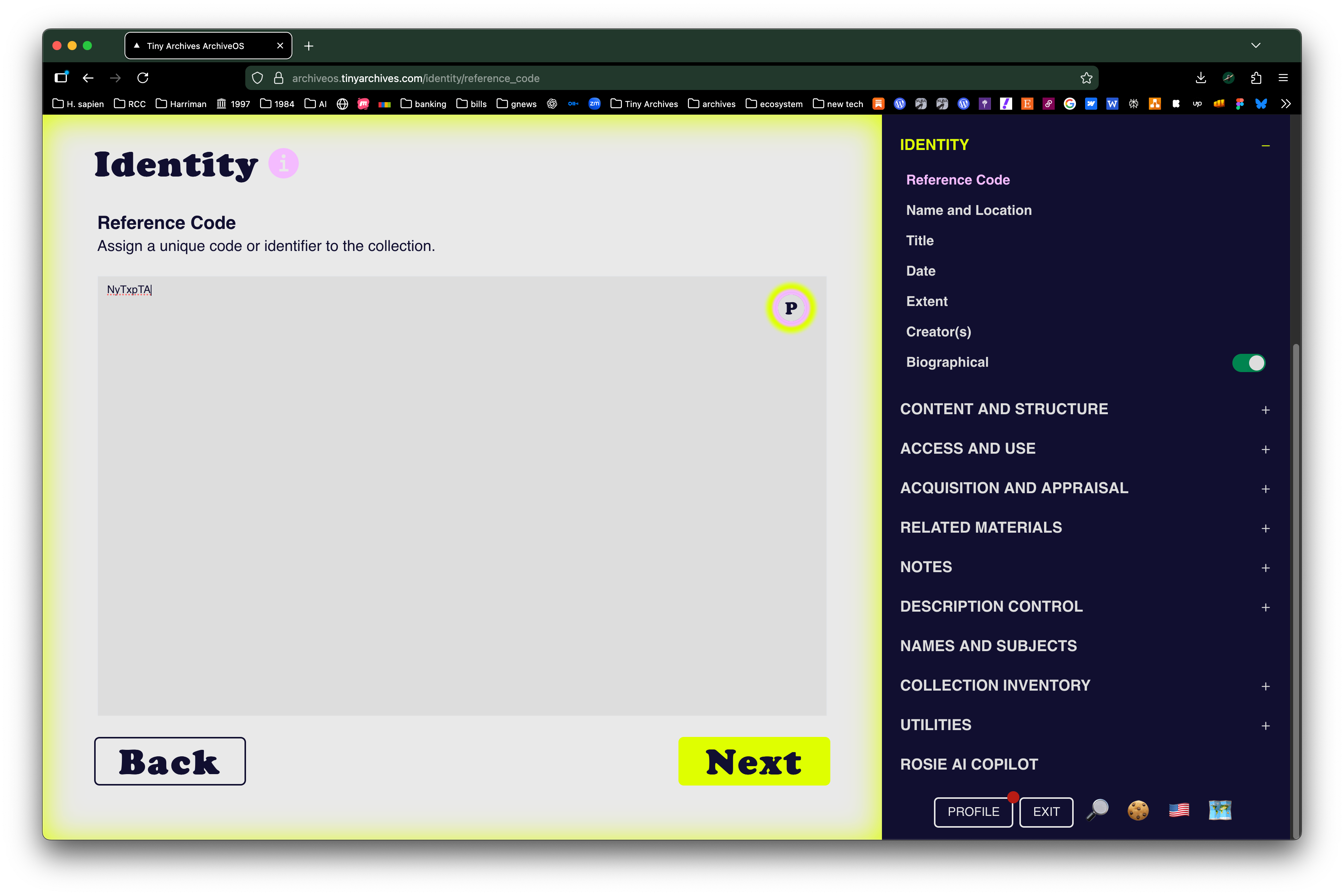
When you create a new finding aid in ArchiveOS, our Reference Code will display as the default.
NyTxpTA
I registered Tiny Archives with the Library of Congress MARC Organizations office. You can leave it, or change it, as you need to. ArchiveOS does not impose character limits or on the structure of your descriptions. My team and I built the platform to make doing the work of archives simple, intuitive, quick, and meaningful.
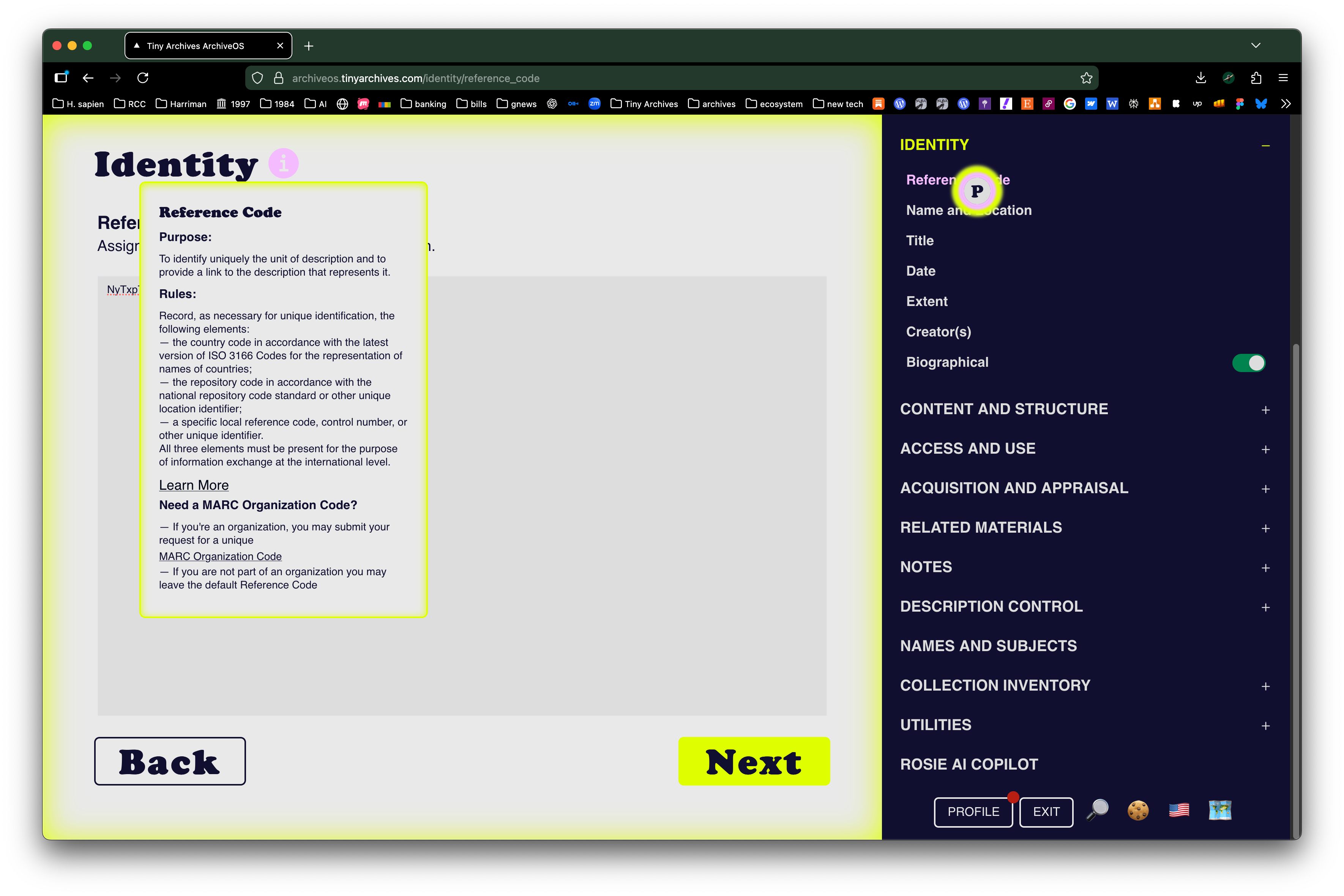
If you’re an archival organization, information and links to request a Reference Code are detailed by clicking the founder pink (i) info button from the Reference Code screen. I kindly ask that only archival organizations submit these requests. By my estimation, one person handles all of the requests received, and they are intended for official organizations only.
⚠️ Rest assured, using our Reference Code by no means implies or confers any ownership by Tiny Archives of your account, archives, or content. It’s simply one thing in the suite of tools we provide for our members, whoever you might be, to create a professional level finding aid for our very personal archives.
ArchiveOS is built for families, individuals, and classrooms, as well as professional archivists and tiny organizations. Very few features in ArchiveOS may not apply to all of our members.
Remember, we’re all here for Archives. I understand folks may arrive here with social media trauma. But this is not a battleground. Except for the battle from Archival Silences. I’ll cover the topic later on in the series when we’ve made more progress building our archives and writing our finding aids.
Reference Code is a three-part code to identify an archival repository. It includes abbreviations for the name of the archive, and the city and state where it’s located.
Our Reference Code tells the world we are located in New York State (Ny), in the town of Tuxedo (Txp), and that it is the Tiny Archives (TA) archival repository.
To dig into the topic and learn more, you can head over to 2.1 Reference Code (Required).
💡 My goal with this series is not to merely repeat what is already detailed in an SAA, DACS, or other major resource or organization, but to share some simple or distilled piece of knowledge from my own experience as an Archivist who has worked with many collections, and apply that to helping our members.
Homework assignment:
Down below in comments, if you have your own Reference Code, or modified it in some way for the collections you steward, please share it with us.
If you have any questions about Reference Codes, you may also add them to the comments below.
If you’re considering to join Tiny Archives, already are a member and have any questions, or if you are one of our Archivists’ Marketplace members, please feel free to send me an email with your questions, comments, and thoughts about ArchiveOS. I will receive your email personally, and will reply to as many as I’m able to.
As we get to know each other and as folks begin to find us, it’s worth repeating. Please, be kind. My team of engineers and I built this for all of us. Nobody has gotten paid. We are good folks who built something so everyone can enter their own darn selves into the historical record. We’ve made that as easy, accessible, and powerful as we could figure out is possible.
Thanks for joining us here today, and for reading this far.
Have a most excellent evening. We look forward to seeing you in the archives.
Kind regards,
Jennifer
Jennifer Frémont
Archivist, Founder and CEO of Tiny Archives
Creator of ArchiveOS
founder@tinyarchives.com
P.s. This was written and edited by a human. Please expect and forgive any and all reasonable human errors and typos among the words above.
✨ Folks who join as an ArchiveOS First Friend, an annual subscription to this here Tiny Archives publication on Substack will receive a coupon code for 100% off a 1-year individual membership to ArchiveOS, if you are a professional archivist we will grant the Archivists’ Marketplace membership, same for families, and you will receive invitations to special Office Hours (themes: coffee time, cocktail hour, rainy day introverts, nice cuppa tea time) where we will work on our collections together. It will make the time fly, and we will all get to meet some interesting people and learn about the archival collections we’re all stewarding.
Thanks for reading! This post is public so please feel free to share it.